

Editorial source: “Harnessing the Power of Phosvitin Derived Peptides for Iron Delivery,” supplied as a manuscript by Dr. Chris D. Meletis, ND.
01 / BASIC SCIENCE
The scientific question
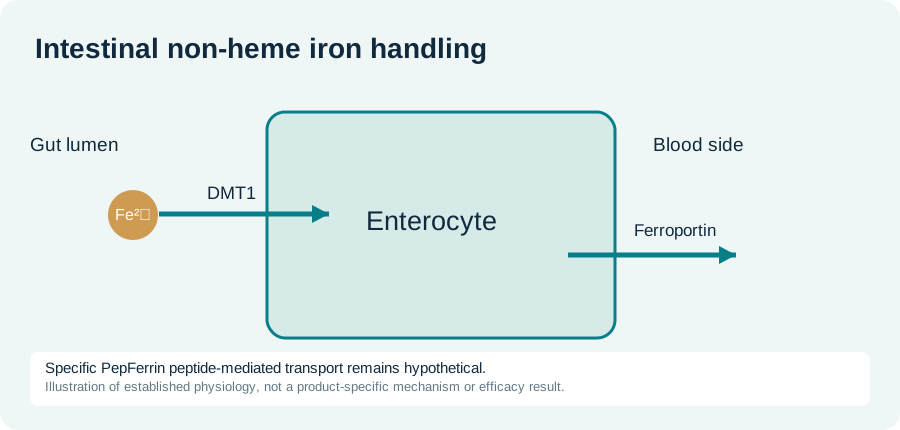
Egg-yolk phosvitin is highly phosphorylated and has strong interactions with minerals including iron. Its iron-binding properties are relevant when studying both egg yolk nutrition and the design of new peptide ingredients.
02 / PEPTIDE CHEMISTRY
Why fragments may differ
Hydrolysing phosvitin produces smaller phosphorylated peptides. A 2011 review by Samaraweera and colleagues examines the potential of egg-yolk phosvitin as a source of bioactive phosphopeptides, including mineral-binding properties. This is a literature review, not a clinical trial of Ferravitin™ or PepFerrin™.
03 / RESEARCH QUESTIONS
What remains unknown
The possibility that specific phosphopeptides alter iron solubility or delivery should be explored with analytical characterization, validated absorption models and controlled human studies. A mechanism of action or clinically important human absorption advantage for PepFerrin™ has not been established by the references below.
Mineral binding and human bioavailability are distinct research questions. Product-specific absorption, comparative tolerability and clinical outcomes require controlled investigation.
04 / CLINICAL CONTEXT
Clinical and regulatory context
Oral iron tolerability varies by formulation and dose. General literature about adverse events with oral iron should not be treated as direct evidence that Ferravitin™ causes fewer adverse events. The existing nine-person internal observation is uncontrolled and is not presented as clinical proof.
05 / SOURCES
Selected references
- Samaraweera H, Zhang W-G, Lee EJ, Ahn DU. Egg yolk phosvitin and functional phosphopeptides—review. Journal of Food Science. 2011;76(7):R143–R150. View publication ↗
- NIH Office of Dietary Supplements. Iron — Health Professional Fact Sheet ↗
- Health Canada. Daily Maintenance NPN 80143362 ↗ and Pregnancy Formula NPN 80143356 ↗.
The submitted Meletis manuscript is distinguished from independently published research. Preliminary N=9 observational data are not evidence of product-specific clinical superiority.